
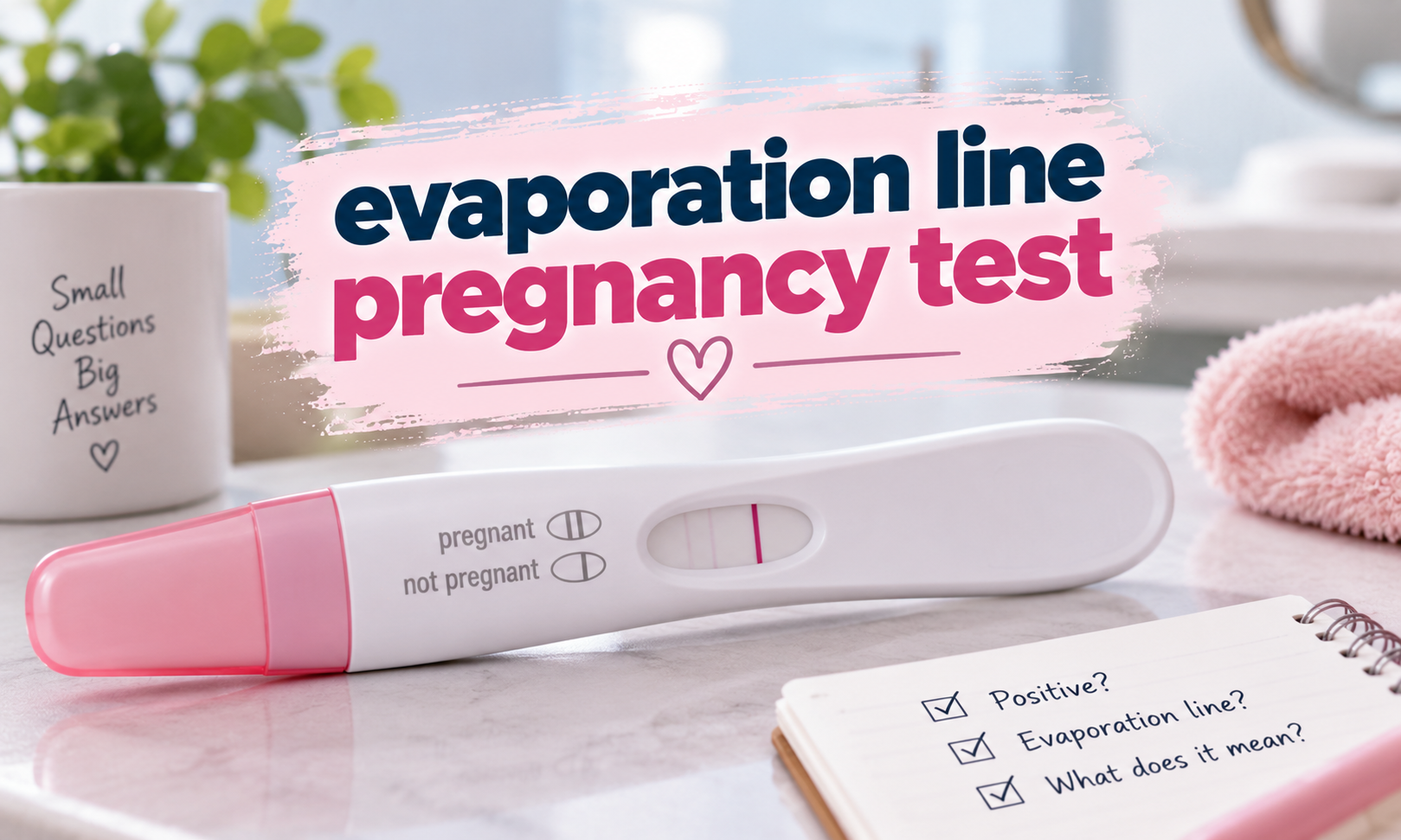
An evaporation line pregnancy test result can be confusing because a faint mark may look like a second test line after the urine on the strip begins to dry. An evaporation line usually develops after the manufacturer’s reading window and often looks gray, colorless, or shadow-like rather than clearly dyed.
A true positive can also be faint, especially very early in pregnancy when urine levels of human chorionic gonadotropin, or hCG, are still low. The safest way to interpret a home test is to follow the exact timing instructions for that brand, read the result only within the stated window, and repeat the test if the result is unclear.
What Is an Evaporation Line on a Pregnancy Test?
An evaporation line is a mark that can appear in the test area as urine dries. It is not caused by hCG and does not confirm pregnancy.
On line-based tests, the result window contains materials that react with urine and, when hCG is present at or above the test’s detection threshold, create a visible test line. As the strip dries, however, a faint indentation, shadow, or residue line can become visible even when the test was negative during the valid reading period.
This is why the result should not be interpreted long after the recommended time. A test that looked negative at five minutes but has a faint line an hour later should not automatically be considered positive.
How Can You Tell an Evaporation Line From a Faint Positive?
| Feature | Evaporation Line | Possible Faint Positive |
| When it appears | Often after the allowed reading window | Usually within the manufacturer’s valid reading time |
| Color | Often gray, colorless, or shadow-like | Usually shows the test’s expected dye color |
| Meaning | Does not confirm pregnancy | May indicate hCG is present |
| What to do | Ignore late result and retest | Repeat in 48 hours to a few days if still uncertain |
| Common cause | Urine drying on the strip | Very early pregnancy or diluted urine |
These clues are helpful, but they are not perfect. Test brands use different dyes, line widths, read times, and result formats. If a line is difficult to interpret, the most reliable next step is usually to repeat the test rather than trying to diagnose the line from a photo.
Why Does Reading the Test Too Late Cause Confusion?
Every home pregnancy test has a specific time window for reading the result. The instructions may tell you to check after two, three, or five minutes and to ignore changes after a later cutoff.
Once urine begins to evaporate, the strip can change appearance. A faint mark that develops after the valid window may be an evaporation line or an indent rather than a pregnancy-related test line.
The FDA guidance on home pregnancy tests emphasizes following the test instructions carefully and notes that brands differ in how they detect low levels of hCG.
Setting a timer can help. Do not rely on memory, and do not re-check a discarded test later in the day.
Can a Faint Line Still Mean You Are Pregnant?
Yes. A faint line that appears within the correct reading window can be a true positive.
Home tests detect hCG in urine. Early in pregnancy, hCG may be present at a relatively low level. A sensitive test may therefore show a faint line before the concentration becomes high enough to produce a darker result.
Urine concentration also matters. Testing after drinking a large amount of fluid may dilute hCG and make the line lighter.
If a faint colored line appears within the instructed time, repeat the test after about 48 hours to a few days or contact a healthcare professional if you need confirmation.
When Is the Best Time to Take a Home Pregnancy Test?
Home pregnancy tests are generally more reliable after the first day of a missed period. Testing earlier increases the chance of a false-negative result because hCG may not yet be high enough for the test to detect.
Mayo Clinic’s 2026 guidance on home pregnancy test accuracy notes that results are more likely to be accurate after the first day of a missed period and that hCG rises quickly in early pregnancy.
The FDA goes further and notes that 10 to 20 out of every 100 pregnant women may not detect pregnancy on the first day of a missed period. That is one reason a negative result should not be considered final if the period still does not start.
Is First-Morning Urine Better for Pregnancy Testing?
First-morning urine can be helpful, especially when testing early. Urine is often more concentrated after several hours without drinking, which can make hCG easier to detect.
Later in pregnancy, the difference may matter less because hCG levels are higher. But if you are testing before or just after a missed period, morning testing can reduce the chance that a very diluted sample hides a low hCG level.
How Do Home Pregnancy Tests Detect hCG?
After implantation, developing placental tissue produces hCG. The hormone enters the bloodstream and eventually appears in urine.
Home pregnancy tests contain antibodies designed to react with hCG. In many line-based tests, urine moves along the test strip and produces a control line to show that the test worked. If enough hCG is present, a second line or symbol appears in the test area.
Digital tests use a similar underlying detection process but display words such as pregnant or not pregnant instead of requiring the user to interpret line darkness.
Does a Darker Pregnancy Test Line Mean a Healthier Pregnancy?
No. Home pregnancy tests are designed mainly to answer whether hCG is detected, not to measure pregnancy health.
Line darkness can change with urine concentration, test sensitivity, brand, timing, and how long the urine contacts the strip. Comparing line darkness from one day to the next is not a reliable substitute for clinical evaluation.
If a healthcare professional needs to evaluate early pregnancy progression, they may use quantitative blood hCG testing, ultrasound, or both depending on the situation.
What Can Cause a False-Negative Pregnancy Test?
| Cause | Why It Happens | What May Help |
| Testing too early | hCG is below the test’s detection level | Retest after the missed period or a few days later |
| Diluted urine | Large fluid intake lowers urine hCG concentration | Use first-morning urine when testing early |
| Checking too soon | The reaction has not finished | Wait exactly as long as the instructions say |
| Expired or damaged test | Test chemistry may not work correctly | Check expiration date and package integrity |
| Incorrect technique | Too much or too little urine can affect the test | Follow the brand’s directions exactly |
What Can Cause a True Positive When You Are Not Currently Pregnant?
A positive hCG test does not always mean an ongoing pregnancy. One common explanation is a very early pregnancy loss after implantation, sometimes called a chemical pregnancy.
Fertility medications that contain hCG can also produce a positive result for a period of time after treatment.
Less commonly, hCG can be detected in other medical situations. In 2026, the American College of Obstetricians and Gynecologists published guidance on positive hCG results in nonpregnant patients, including causes such as pituitary hCG, assay interference, and certain tumors.
Those uncommon situations are discussed in ACOG’s 2026 clinical guidance on positive hCG results.
They are not reasons to panic after one confusing home test. The practical first step is usually repeat testing or clinical confirmation.
Can an Evaporation Line Have Color?
Evaporation lines are often described as colorless or gray, but real-world tests do not always look perfectly clear. Lighting, the test strip’s indentation, leftover dye, camera filters, and the user’s perception can make a late mark look slightly colored.
That is why timing is more important than appearance alone. A line that develops after the test’s allowed interpretation window should not be treated as a reliable positive even if it looks faintly tinted.
What Is an Indent Line and Is It the Same as an Evaporation Line?
An indent line is the physical groove or area where a positive test line is designed to develop. On some tests, that indentation can be visible even when no dye has collected there.
An evaporation line develops as the urine dries. In practice, users may use the terms interchangeably because both can create a faint shadow that is mistaken for a positive result.
Again, the important question is whether a clearly dyed result appeared within the test’s stated reading window.
Do Blue-Dye Tests Have More Evaporation Lines Than Pink-Dye Tests?
Many online discussions claim that blue-dye tests are harder to interpret because faint blue shadows can be mistaken for positives. However, the practical issue is not simply the dye color.
Any line-based pregnancy test can become confusing if read after the valid time window. Test sensitivity, manufacturing design, urine concentration, and lighting all influence what a faint result looks like.
If you regularly find line tests stressful to interpret, a digital test may reduce visual ambiguity, although digital tests can still produce false-negative results if used too early.
How Soon Should You Retest After an Unclear Result?
If the line is unclear, repeat the test in about 48 hours to a few days, preferably with first-morning urine and a new, unexpired test.
In early pregnancy, hCG usually rises quickly, so a true pregnancy may be easier to detect after a short wait. Mayo Clinic notes that hCG levels in early pregnancy often increase rapidly, commonly doubling every two to three days.
If your period is late and repeated home tests remain negative, contact a healthcare professional. Pregnancy is not the only reason a period may be delayed.
Should You Use the Same Brand When Retesting?
Using the same brand can make comparisons simpler because the tests may have similar sensitivity and line design. However, you do not need to use the same brand for the next result to be meaningful.
More important factors are testing at the correct time, following the instructions exactly, and using an unexpired test.
Avoid comparing line darkness between different brands because their dye systems and hCG detection thresholds may differ.
Can a Digital Pregnancy Test Prevent Evaporation-Line Confusion?
Digital tests remove the need to interpret a faint line by displaying a word result. That can be helpful for people who find line-based tests stressful.
However, a digital test is not immune to timing problems. Testing too early can still produce a negative result in someone who is pregnant because hCG has not yet risen above the test’s detection threshold.
If a digital test is negative but your period does not start, repeat the test later or contact a healthcare professional.
What Should You Do After a Positive Home Pregnancy Test?
A positive home test is a reason to contact your healthcare professional and arrange appropriate prenatal care.
Depending on your medical history, symptoms, timing, and prior pregnancy history, the clinician may confirm pregnancy with another urine test, a blood test, ultrasound, or simply schedule routine prenatal follow-up.
If you take prescription medications, do not stop them on your own because of a positive test. Ask the prescribing clinician or pharmacist whether any changes are needed.
When Is a Pregnancy-Test Result an Emergency?
A confusing test line itself is not usually an emergency. However, a positive or possibly positive pregnancy test combined with certain symptoms needs prompt medical attention.
Seek urgent care for severe or one-sided pelvic or abdominal pain, heavy bleeding, fainting, severe dizziness, shoulder pain, or signs of shock. These symptoms can occur with serious problems such as ectopic pregnancy or significant bleeding and should not be managed by repeatedly testing at home.
How Can You Reduce the Chance of an Evaporation-Line Mistake?
| Step | What to Do | Why It Helps |
| Check the expiration date | Use an unexpired, sealed test | Old test chemistry may be unreliable |
| Read instructions first | Know sample method and timing before starting | Prevents timing mistakes |
| Use a timer | Read at the exact recommended time | Reduces late-read evaporation confusion |
| Test after a missed period | Wait until hCG is more likely to be detectable | Reduces false negatives |
| Use morning urine when testing early | Test before heavy fluid intake | Provides a more concentrated urine sample |
| Discard after reading | Do not revisit the test later | Prevents interpreting evaporation changes |
| Retest if uncertain | Use a fresh test 48 hours to a few days later | Allows time for hCG to rise if pregnancy is present |
Frequently Asked Questions About Evaporation Lines
What does an evaporation line look like on a pregnancy test?
It is usually a faint gray, colorless, or shadow-like line in the test area that appears after the valid reading time as urine dries.
Can an evaporation line appear within five minutes?
Timing varies by brand, so five minutes may still be inside the valid window for one test and too late for another. Always use the exact instructions supplied with your test.
Does a faint line always mean pregnancy?
No. A faint colored line within the valid reading window may be a true positive, but a line that appears after the allowed time may be an evaporation or indent line.
How long after a faint test should I retest?
If the result is unclear, retest in about 48 hours to a few days using a fresh test. First-morning urine may help when testing very early.
Can drinking too much water cause a faint pregnancy test?
Yes. Large amounts of fluid can dilute urine and lower the hCG concentration, making an early positive line harder to see or contributing to a false-negative result.
Can a pregnancy test turn positive after sitting for an hour?
A late change should not be considered a valid result unless the manufacturer specifically says that time is within the reading window. Most tests should be interpreted only during the stated time period.
Are digital pregnancy tests more accurate than line tests?
Not necessarily. Digital tests can be easier to interpret, but both types depend on detecting hCG and can be negative if taken too early.
When should I call a healthcare professional after a confusing test?
Call if repeated tests are mixed, your period remains absent despite negative tests, or you want confirmation. Seek urgent care for severe pain, heavy bleeding, fainting, or severe dizziness with a positive or possibly positive test.
Final Thoughts
An evaporation line can look convincing, but timing is the most important clue. If a faint line appears only after the pregnancy test’s valid reading window, it should not be treated as a reliable positive result.
A faint colored line that appears within the instructed time may represent an early pregnancy, particularly if testing was done close to a missed period. Retesting after 48 hours to a few days with first-morning urine can often provide a clearer answer.
If home results remain confusing, a healthcare professional can help confirm whether hCG is present and determine whether any additional testing is needed. And if a positive or possibly positive test is accompanied by severe pain, heavy bleeding, fainting, or severe dizziness, seek prompt medical care rather than relying on another home test.
This article is written for a U.S. audience using pregnancy-test guidance available in October 2026. It is general educational information and is not a substitute for medical diagnosis or individualized care.