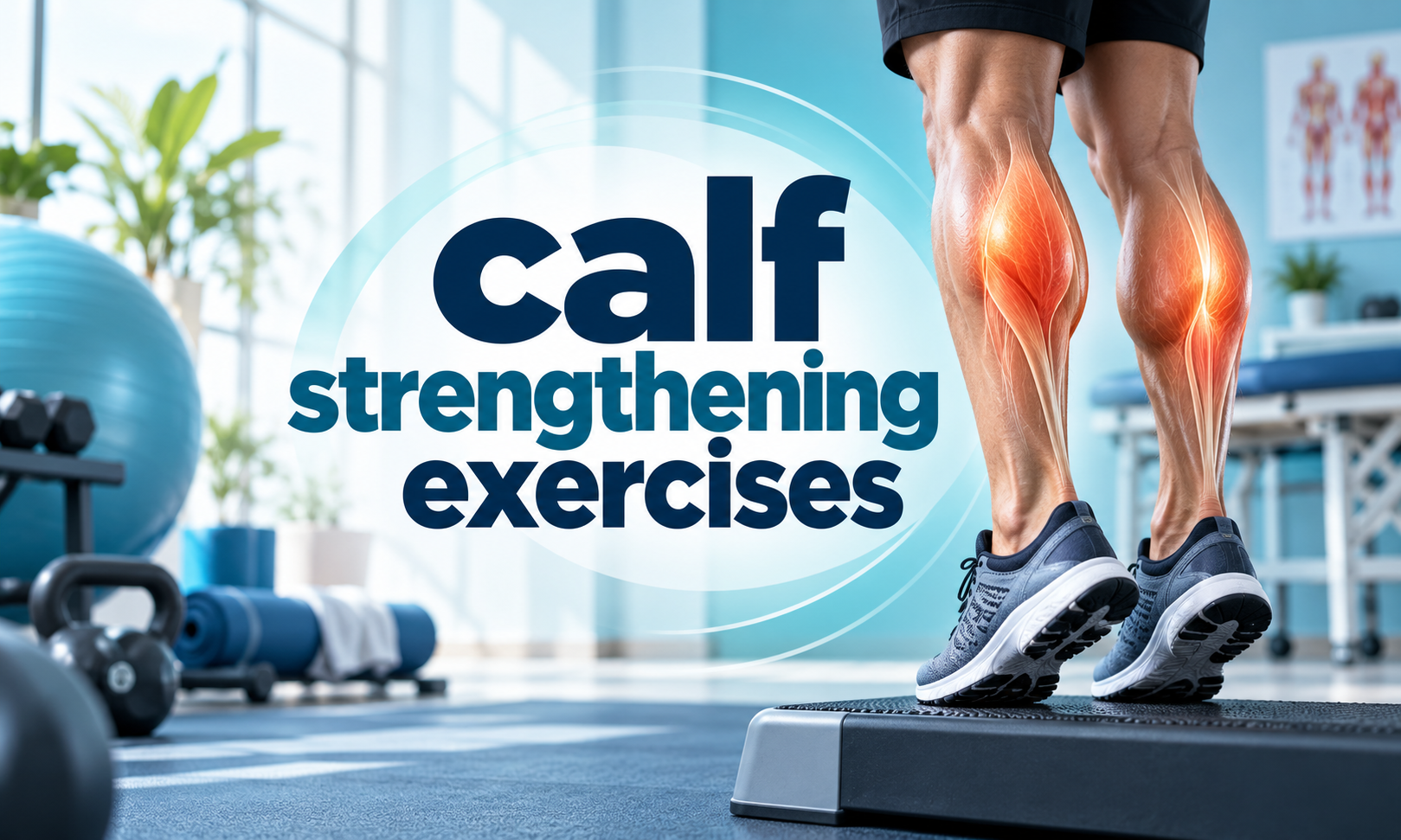
Calf strengthening exercises can improve lower-leg strength for walking, running, climbing stairs, jumping, and balance. The calf is not a single muscle: the gastrocnemius forms the rounded outer shape, while the deeper soleus contributes heavily to endurance and ankle stability. Both connect into the Achilles tendon and help lift the heel when you push off the ground.
The WebMD calf-strengthening guide recommends calf raises as a simple foundation and includes double-leg, single-leg, and seated variations. A good program starts with controlled body-weight work, then increases the challenge gradually instead of chasing high repetitions with poor form.
Which Calf Exercises Should You Start With?
| Exercise | Main emphasis | Good starting target | Progression |
| Double-leg calf raise | Gastrocnemius + soleus | 2 sets of 8-12 | Add reps, then load |
| Single-leg calf raise | Greater strength per leg | 1-2 sets of 6-10 | Add load or use a step |
| Seated calf raise | More soleus emphasis | 2 sets of 8-12 | Add weight on thighs |
| Bent-knee calf raise | Soleus/endurance | 2 sets of 10-15 | Hold weight or slow tempo |
| Band plantar flexion | Calf + ankle control | 2-3 sets of 10 | Use a stronger band |
Why Are the Calf Muscles Important?
Every step requires the calf to control the ankle and push the body forward. Strong calves also help with balance and absorb force during running and jumping.
Exercises with a straighter knee generally place more demand on the gastrocnemius, while bent-knee and seated variations shift more work toward the soleus.
How Do You Do a Double-Leg Calf Raise?
Stand near a wall, counter, or sturdy chair for balance. Place your feet about hip-width apart with the knees and hips facing forward. Slowly press through the balls of both feet and lift your heels as high as you comfortably can. Pause briefly, then lower under control.
Avoid bouncing or rolling the ankles outward. Increase controlled repetitions before adding external weight.
How Many Double-Leg Raises Should You Do?
The AAOS Foot and Ankle Conditioning Program uses 2 sets of 10 calf raises in its conditioning program. General strength guidance also commonly uses the 8-12 repetition range. The correct starting volume is the amount you can complete with steady balance and full control.
When Should You Progress to Single-Leg Calf Raises?
Move to a single-leg version when double-leg raises no longer feel challenging and you can complete them without leaning heavily on support. Stand on one foot, keep a hand near a wall or chair, rise onto the ball of the foot, and lower slowly.
Single-leg work exposes side-to-side differences. If one calf is weaker, let that side determine how many clean repetitions you perform.
Should You Do Calf Raises on a Step?
A step can increase range of motion by allowing the heel to lower below the level of the toes. Start this variation only after you are comfortable on flat ground. Keep the ball of the foot securely on the step and use a railing or wall for balance.
Do not force the heel downward into a painful stretch. People with an irritated Achilles tendon or recent ankle injury may need a smaller range or a rehabilitation-specific plan.
How Do Seated Calf Raises Work?
Sit on a sturdy chair with the feet flat and knees bent. Keep the knees aligned over the feet, then lift the heels while the balls of the feet stay on the floor. Lower slowly.
To increase resistance, place your hands on the thighs or use a safely positioned weight. The bent knee shifts more work toward the soleus.
What Is a Bent-Knee Calf Raise?
Stand while holding a stable surface, bend the knees slightly, and keep them bent throughout the set. Rise onto the toes without straightening the knees, pause, and lower slowly. The movement should come mainly from the ankles.
This variation challenges the soleus more than a straight-knee raise. Keep the range comfortable and avoid turning the feet excessively inward or outward.
How Do You Strengthen the Calf With a Resistance Band?
The AAOS resistance-band plantar-flexion exercise is a useful option when standing raises are too difficult or when you want more ankle-specific control. Sit with the leg supported, loop a resistance band around the forefoot, hold the ends, and slowly point the toes away against the band. Return with control.
Avoid snapping the foot back. AAOS uses 3 sets of 10 for plantar-flexion work in its conditioning program, but beginners can start with less resistance and fewer sets.
How Often Should You Train Your Calves?
For general fitness, the CDC strength-training guidance recommends muscle-strengthening activity at least 2 days per week and suggests 8-12 repetitions per exercise, with additional sets providing more benefit. Two or three calf sessions per week works well for many people.
More frequent work may be appropriate in rehabilitation, but avoid adding weight, sets, and frequency all at once.
How Should You Progress Calf Exercises?
Progress only when your current version feels controlled and leaves no unusual pain afterward. You can make calf work harder by adding repetitions, slowing the lowering phase, increasing range of motion, moving from two legs to one, or adding resistance.
WebMD recommends increasing load gradually rather than making large jumps. A modest increase every couple of weeks is more sensible than doubling the weight because one workout felt easy.
What Are Common Calf-Raise Mistakes?
- Bouncing quickly instead of lifting and lowering under control
- Rolling the ankles outward or inward at the top
- Using a range of motion that causes Achilles or ankle pain
- Holding the breath during heavier sets
- Adding weight before mastering body-weight form
- Training through sharp pain, swelling, or a recent calf strain
Do You Need to Stretch Your Calves Too?
Strength and flexibility serve different purposes. Stretching can help maintain ankle motion, but it does not replace strengthening.
Stretching should feel like tension, not sharp pain. Aggressive stretching is not appropriate immediately after an acute calf or Achilles injury unless a clinician has recommended it.
When Should You Stop Exercising and Get Medical Advice?
Stop the exercise if you feel a sudden pop, sharp pain, or rapidly increasing pain in the calf or Achilles region. Difficulty pushing off the foot, inability to rise onto the toes, or significant bruising may indicate a muscle or tendon injury.
Exercise is also not the right response to unexplained one-sided calf swelling, warmth, tenderness, or skin discoloration. WebMD notes that these symptoms can signal a serious problem such as a blood clot and need prompt medical evaluation.
Frequently Asked Questions About Calf Strengthening Exercises
What Is the Best Calf Exercise for Beginners?
Double-leg calf raises with light hand support are usually the simplest starting point. They let you practice alignment, balance, and a controlled range before progressing to one leg or added weight.
Do Calf Raises Make Calves Bigger?
They can increase calf size with enough resistance, recovery, and nutrition, although genetics strongly influence muscle shape.
Can Walking Strengthen the Calves?
Yes, especially walking uphill or hiking. Walking provides endurance work, but targeted calf raises make it easier to progressively overload the muscles for strength.
Can I Train Calves Every Day?
Harder strength sessions usually benefit from recovery. For general fitness, two or three focused calf sessions per week is a practical starting point.
What Is the Bottom Line?
Effective calf strengthening exercises do not need to be complicated. Start with controlled double-leg raises, progress to single-leg work, and include seated or bent-knee variations to challenge the soleus. Resistance-band plantar flexion is another useful option when you need lower-load training.
Use slow, controlled repetitions, progress gradually, and stop if an exercise causes sharp pain. If calf weakness is sudden, affects only one side, or comes with swelling, tenderness, numbness, or discoloration, seek medical evaluation rather than trying to train through it.