
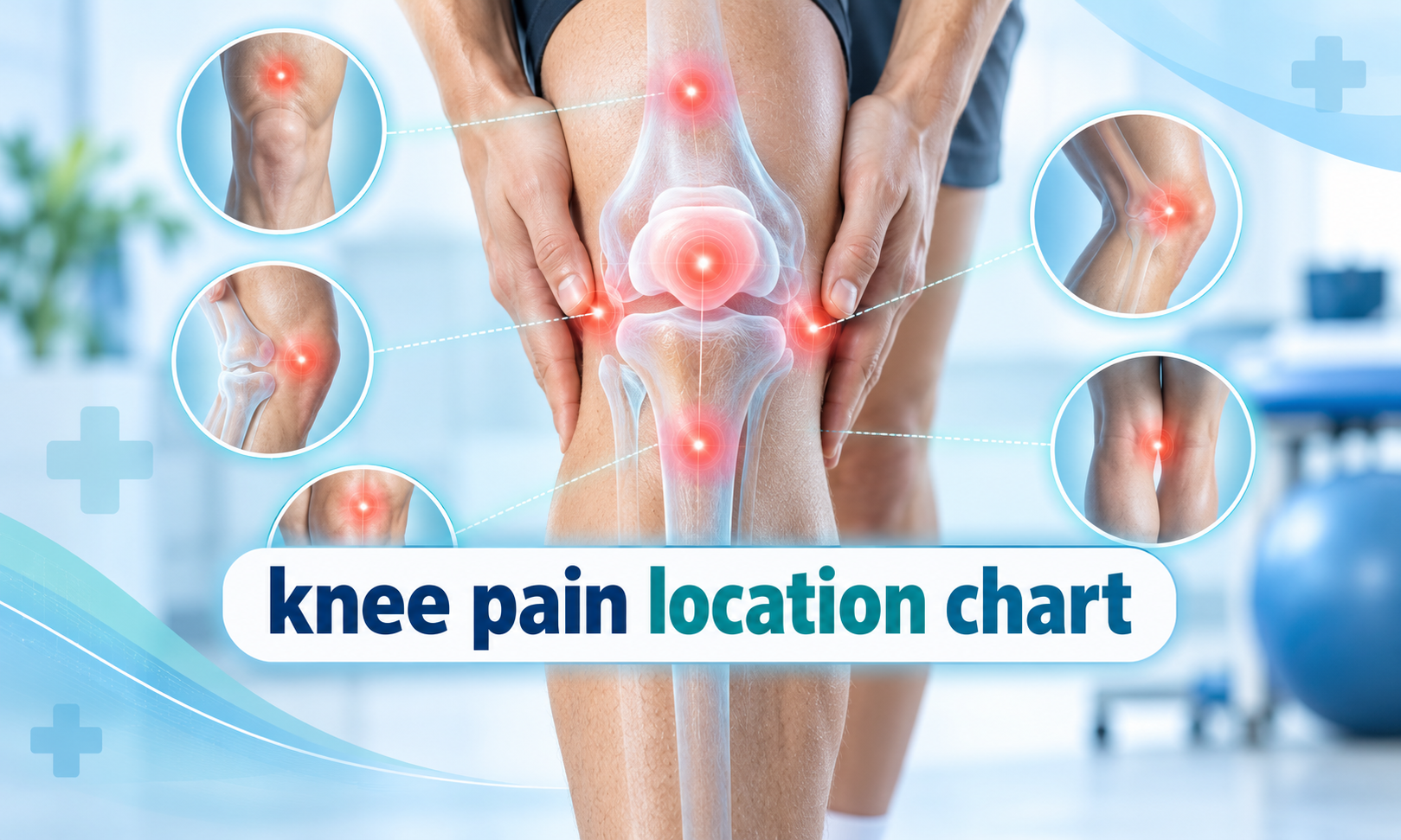
A concise guide to pain above, below, inside, outside, behind, and around the kneecap
A knee pain location chart can help narrow down possible causes by showing where common knee problems tend to hurt. Pain at the kneecap may point toward patellofemoral problems, inner-knee pain can occur with an MCL or medial meniscus injury, and pain behind the knee can be linked with a Baker’s cyst, tendon irritation, arthritis, or other conditions.
Location is only one clue. Swelling, instability, locking, a recent injury, fever, and whether the pain occurs during running, stairs, bending, or rest all matter. A location chart should guide questions, not replace a medical diagnosis.
Quick Knee Pain Location Chart
| Where It Hurts | Common Possibilities | Typical Clues |
| Front / around kneecap | Patellofemoral pain, cartilage irritation, patellar tracking problems | Often worse with stairs, squats, running, or prolonged sitting |
| Above kneecap | Quadriceps tendon irritation, bursitis, arthritis-related pain | Tenderness above the patella or pain when extending the knee |
| Below kneecap | Patellar tendinitis; in adolescents, Osgood-Schlatter disease | Pain at or below the tendon, often with jumping or running |
| Inner side | MCL sprain, medial meniscus injury, pes anserine bursitis, arthritis | Pain along the side nearest the other knee; twisting or impact may be relevant |
| Outer side | IT band syndrome, LCL injury, lateral meniscus problem | Common with repetitive running or side impact |
| Behind knee | Baker’s cyst, hamstring or calf tendon irritation, meniscus injury, arthritis | Tightness, fullness, or pain when bending or straightening |
What Does Pain at the Front of the Knee Usually Mean?
Front-of-knee pain is commonly associated with patellofemoral pain syndrome, sometimes called runner’s knee. It often hurts around or behind the kneecap and may worsen with stairs, squatting, running, jumping, or sitting with the knee bent for a long time.
Other possibilities include cartilage irritation under the kneecap, patellar instability, or a direct bruise. A painful pop, major swelling, or inability to straighten the knee suggests the need for prompt assessment rather than assuming it is simple overuse.
The American Academy of Orthopaedic Surgeons describes patellofemoral pain syndrome as pain in the front of the knee and around the kneecap, particularly in active people.
What Can Pain on the Inner Side of the Knee Suggest?
Pain on the inner, or medial, side can occur with an MCL sprain after the knee is forced inward from the outside. A medial meniscus injury may cause pain after twisting and can sometimes produce catching, locking, or swelling.
Pes anserine bursitis can also cause tenderness slightly below the joint line on the inner side. In adults with gradually increasing stiffness and aching, osteoarthritis is another possibility.
What Causes Pain on the Outer Side of the Knee?
Outer-knee pain is often associated with iliotibial band syndrome in runners and cyclists. Repeated bending and straightening can irritate tissues where the IT band passes near the outside of the knee.
Other causes include an LCL sprain, lateral meniscus injury, arthritis, or trauma. Pain that follows a clear impact or twisting injury deserves a different evaluation from pain that slowly appears after increased mileage or training volume.
What Does Pain Below the Kneecap Mean?
Pain just below the kneecap often involves the patellar tendon. Patellar tendinitis, also called jumper’s knee, is commonly linked with repeated jumping, sprinting, or sudden increases in training.
In growing children and teenagers, tenderness at the bony bump below the knee can occur with Osgood-Schlatter disease. Persistent pain in a young athlete should be assessed rather than treated as ordinary soreness.
Why Does the Back of the Knee Hurt?
Pain behind the knee can come from several structures. A Baker’s cyst can create a sense of fullness or pressure behind the joint, often because another knee problem has increased joint fluid. Hamstring or calf tendon irritation, arthritis, and meniscus injuries can also produce posterior pain.
Sudden calf swelling, warmth, redness, or shortness of breath should not be assumed to be a knee problem. Those symptoms can occur with a blood clot and require urgent medical evaluation.
Can Knee Pain Location Diagnose the Problem by Itself?
No. Pain patterns overlap. A meniscus injury may hurt along the joint line but can also feel deep inside the knee. Arthritis can cause pain around several areas, and swelling can make the location difficult to pinpoint.
Clinicians combine the location with your history, physical examination, range of motion, stability tests, and sometimes X-rays or MRI. The mechanism of injury is especially important when pain started suddenly.
When Should Knee Pain Be Checked Urgently?
Seek prompt medical care if the knee looks deformed, swells suddenly after an injury, cannot support your weight, or will not fully bend or straighten. A fever with a red, hot, swollen knee also needs urgent assessment because infection is possible.
Mayo Clinic advises medical evaluation for marked swelling, instability, inability to fully move the knee, visible deformity, severe injury-related pain, or fever with redness and warmth.
What Can You Do for Mild Knee Pain at Home?
If there was no major trauma and you can still walk, a short period of activity modification may help. Avoid movements that clearly increase pain, use a wrapped cold pack for short periods if the knee is swollen, and gradually return to activity as symptoms settle.
Long-term improvement often depends on addressing the cause. Strengthening the quadriceps, hamstrings, hips, and glutes can support the knee, but exercises should not produce sharp pain. Persistent or recurrent symptoms are a reason to see a clinician or physical therapist.
Frequently Asked Questions About Knee Pain Location
Where is arthritis knee pain usually felt?
Arthritis can cause pain at the joint line, around the kneecap, or throughout the knee. Stiffness, swelling, and pain after inactivity are also common clues.
What does pain on the inside of the knee mean?
Possible causes include an MCL sprain, medial meniscus injury, pes anserine bursitis, or arthritis. The cause depends on how the pain started and which movements trigger it.
What causes pain behind the knee?
Common possibilities include a Baker’s cyst, tendon irritation, arthritis, or meniscus injury. Sudden calf swelling or breathing symptoms need urgent medical care.
Why does my kneecap hurt when I climb stairs?
Patellofemoral pain is a common cause because stairs increase load around the kneecap. Other causes are possible, especially if there is swelling, instability, or a recent injury.
When is knee pain serious?
Seek urgent care for major deformity, inability to bear weight, severe sudden swelling, intense pain after injury, or a hot red swollen knee with fever.
Final Thoughts
A knee pain location chart is useful for organizing possibilities, but the same area can hurt for several different reasons. Front pain often involves the kneecap, inner and outer pain can involve ligaments or menisci, and pain behind the knee may come from a cyst, tendon, cartilage, or arthritis.
Pay attention to how the pain began, what movements trigger it, and whether there is swelling, locking, instability, redness, or fever. Mild overuse pain may improve with short-term self-care, but persistent symptoms or any red-flag signs deserve medical evaluation.
This article is for general U.S. health education and does not diagnose knee pain. Location alone cannot identify the cause. Seek individualized medical advice for persistent, severe, traumatic, or worsening symptoms.